For years, people said TV was dead. But the truth is that linear TV (with its fixed schedule and real-time programming) had already been in gradual decline since the early 2000s—well before streaming exploded in the U.S. around 2012–2015. The rise of the internet, social media, audience fragmentation, and new digital habits were already stealing screen time for decades, starting a slow erosion.
Then came streaming and accelerated the process: we’ve never had so many options to watch, yet the feeling of exhaustion has only grown. The problem shifted from accessing content to the overwhelming number of choices.
Today, many people spend more time browsing catalogs than actually watching anything. Decision fatigue has become a real, documented phenomenon.
The Exhaustion of Streaming and Personalization
Streaming solved distribution, but it didn’t fully solve the experience. Algorithms learn fast, yet they tend to deliver endless variations of the same pattern.
The promise of personalization turned into comfortable repetition. Similar series, predictable movies, suggestions based on old habits. The sense of discovery has dropped dramatically.
Instead of freedom, many users feel fatigue. The question stopped being “What do I want to watch?” and became “Why is it so hard to choose?”
Why Live Events Remain Relevant
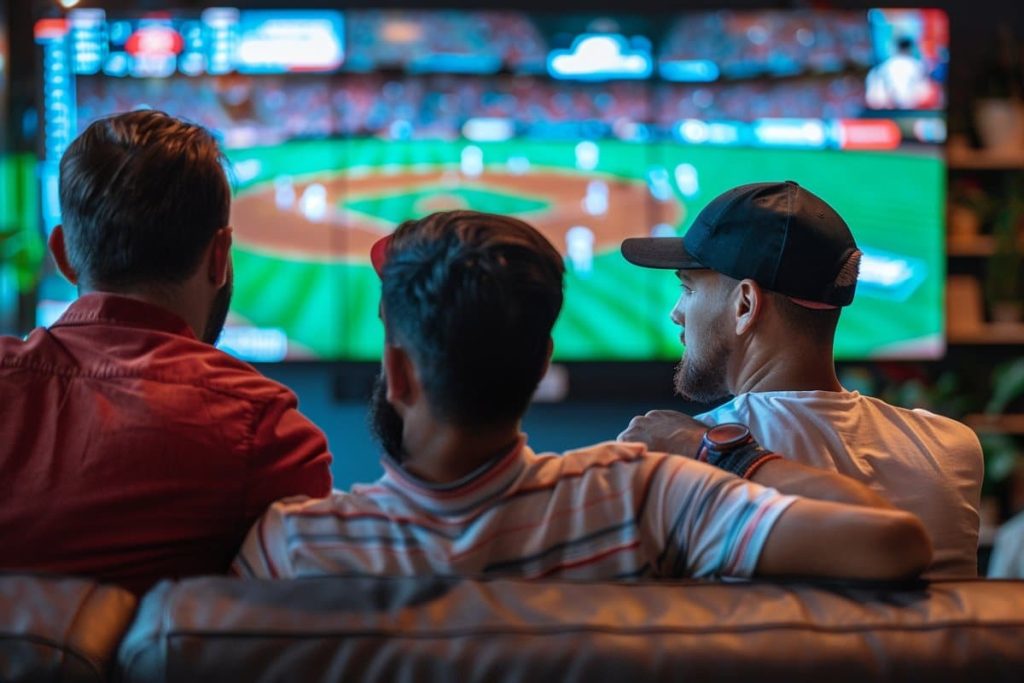
Meanwhile, live content continues to thrive—thanks to the shared experience it creates. The Super Bowl still stops the country: families and friends gather, rooting together, reacting to every play, and talking about it the next day at work or school. NFL Thanksgiving Day games draw record crowds (like the 2025 Chiefs-Cowboys game averaging 57M viewers), with bars packed and conversations buzzing nationwide. March Madness (the NCAA Final Four) unites millions during the tournament, with office pools and watch parties everywhere. And the Oscars or major finales become cultural moments—everyone watching, tweeting, and debating the winners in real time.
These moments aren’t just entertainment: they create a shared reality. Remember finales that emptied the streets? The Friends series finale in 2004 drew 52.5 million viewers, with water-cooler talk dominating offices the next day. The 1996 “The One After the Super Bowl” episode hit 52.9 million—people rushing home to watch together, and the whole country buzzing afterward. It’s this simultaneous connection—watching together, reacting together, remembering together—that on-demand streaming still can’t fully replicate.
This isn’t nostalgia. It’s pure human behavior: the need to belong to something bigger, to share emotions in real time, and to have common topics the next day.
TV in the Age of AI: Return or Transformation?
With advances in artificial intelligence, the future likely won’t involve endlessly choosing what to watch, but being guided to what’s happening right now and matters in the moment—including highlighting live events worth watching together.
Fewer infinite catalogs, more flow. Fewer exhausting decisions, more relevant context. AI can go beyond recommending content: it organizes the experience in a more human way, creating personalized guides, spotlighting what everyone’s talking about in real time, and even adding interactivity for voting or live reactions.
In this scenario, TV doesn’t return exactly as it was. It transforms. In May 2025 (latest Nielsen Gauge data), streaming surpassed combined broadcast and cable for the first time (44.8% vs. 44.2%), but linear TV still holds a strong share in ad-supported viewing (~57% broadcast + cable combined). What’s surging is the linear and flow experience, especially through FAST channels (Free Ad-Supported Streaming TV) like Pluto TV, Tubi, The Roku Channel, and Samsung TV Plus, which are growing rapidly in the U.S. in 2026—offering free, no-subscription grids that mimic traditional TV on smart TVs (Tubi over 100M MAU, Roku Channel reaching ~145M households). Looking ahead, ATSC 3.0 (NextGen TV), now reaching 76% of the U.S. in 2025 and expanding in 2026, promises to blend free over-the-air broadcasting with interactivity and superior quality, reinforcing this collective transformation.
Of course, on-demand streaming isn’t going anywhere—it keeps growing and breaking records. But it’s being forced to relearn from TV the value of “happening together,” “lean-back viewing,” and contextual curation.
Live events, real-time curation, and collective experiences gain new life in a world tired of endless algorithmic decisions.
Maybe the mistake was never TV itself, but trying to turn every audiovisual experience into an endless list.
When the algorithm gets tired, we might discover that television wasn’t dying—it was just transforming.